
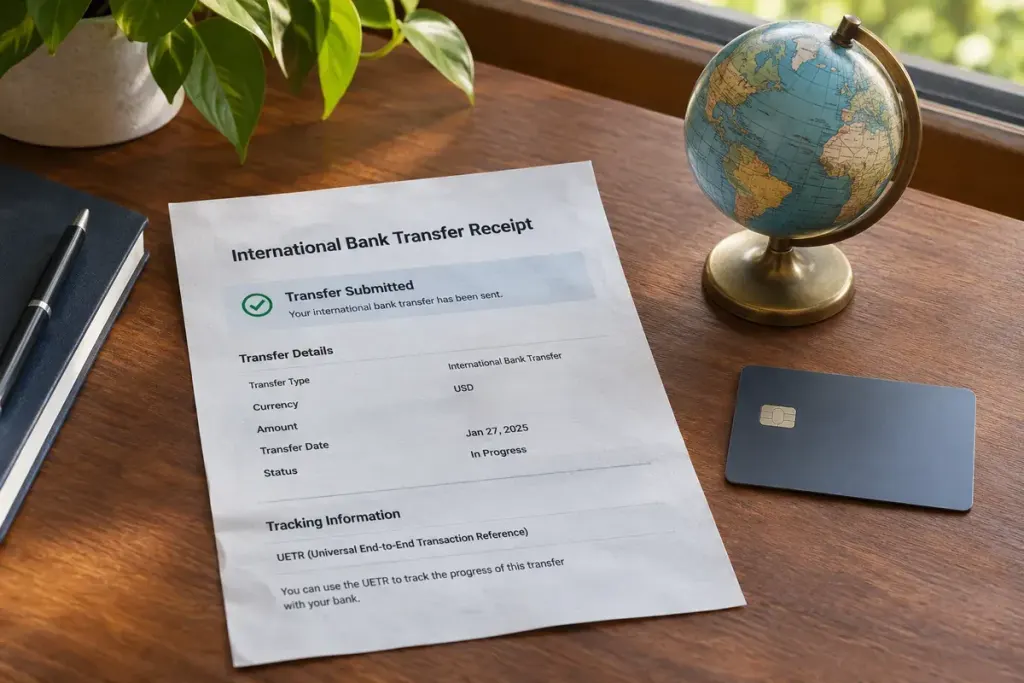
You have a transfer receipt, but the recipient still cannot see the money. Sending another screenshot may repeat information everyone already has. For a payment sent through Swift, a more useful question is whether your bank can supply and trace its Unique End-to-end Transaction Reference, or UETR.
One reference across the journey
Swift describes the UETR as a 36-character identifier carried through the payment chain. Intermediaries pass it onward rather than replacing it with a new tracking reference. That continuity helps participating institutions investigate the same payment even when their internal reference numbers differ.
The UETR is not your account number, an IBAN, or the message you put in a payment’s reference field. A customer-facing receipt may show several identifiers. Ask the bank which one is the UETR instead of assuming the longest string must be it.
Make the investigation specific
A useful enquiry can read: “Please confirm the UETR for this transfer, its latest recorded status, the time of that status, and what action is needed from me.” Keep the transfer date, amount, currency and recipient details available through the bank’s secure channel. If the receiving bank needs the reference, share it privately with the intended recipient.
For example, a sender’s “completed” screen and a recipient’s empty balance may refer to different stages. Ask whether the update means the instruction left the sending bank, reached another institution, or was credited to the beneficiary. A timestamp makes that answer much easier to compare.
Access to tracking is also a service question. Swift’s tools serve financial institutions; possessing a UETR does not automatically give you a public tracking page. Use your bank’s own app or verified support route, rather than entering financial details into an unfamiliar tracking website.
Finally, a reference is an identifier, not proof that money has arrived. Before releasing goods or sending a replacement payment, confirm the actual outcome with the relevant bank. Keep the investigation number alongside the UETR so later conversations can continue from the same record.