
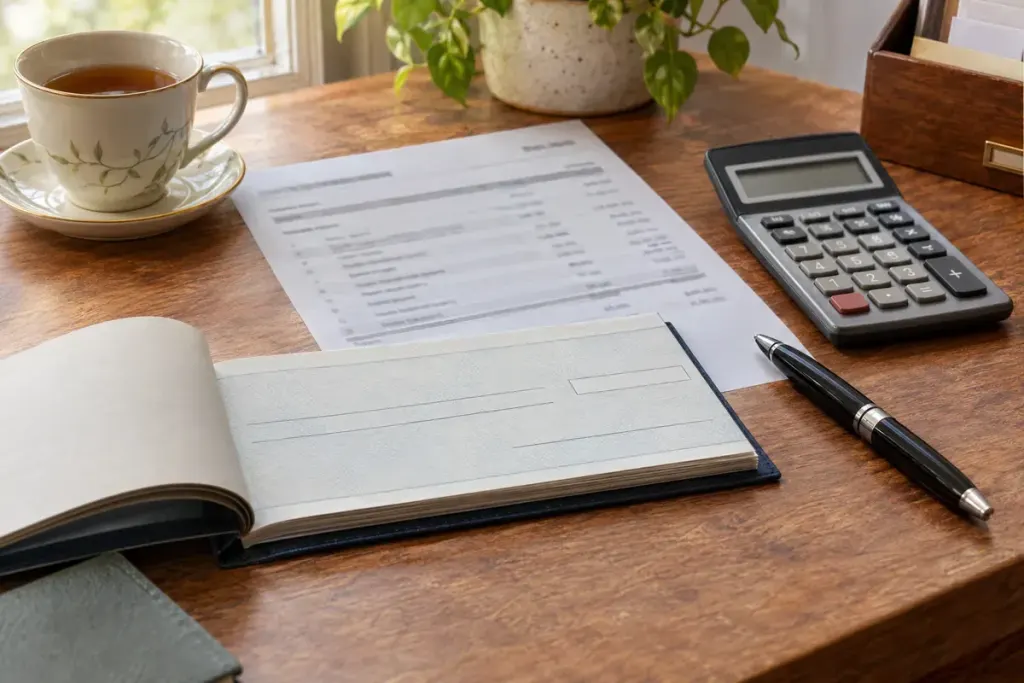
The statement ends with more money than your own record shows. Before treating the difference as spare cash, look for a cheque you have already written but the recipient has not yet presented. That payment can be real in your records while still absent from the bank’s completed transactions.
A reconciliation connects two records taken at the same point in time. It does not force one balance to match the other by deleting inconvenient entries. The Bank of America reconciliation worksheet includes outstanding withdrawals among the adjustments to the statement balance.
Follow one payment through both records
Suppose your own closing balance is 900, while the statement shows 1,100. You recorded a 200 cheque before the statement date; the bank has not processed it. Subtracting that outstanding payment from the statement balance produces 900. This is an illustrative example with one difference, not a complete reconciliation for every account.
Write down the cheque number, payee, amount and issue date. Match it to later transactions when it clears. Do not enter the same expense again simply because it has now appeared on the statement: the later event explains the timing difference.
Keep a separate place for unexplained items
A missing cheque is only one possibility. A bank charge may be on the statement but missing from your records. A deposit may have been recorded before reaching the bank. An amount may also have been mistyped. Each explanation needs its own evidence and adjustment on the appropriate side.
If an issued cheque remains outstanding unusually long, contact the payee and the bank through established channels. Ask about the applicable validity, replacement and stop-payment process before issuing another payment. These rules vary, and a reconciliation alone cannot establish that the original can no longer be paid.
Keep the dated reconciliation with the supporting statement. Next month, start from the unresolved-item list rather than rediscovering the same difference. The useful result is a balance you can explain, alongside a clear record of payments that still need attention.