
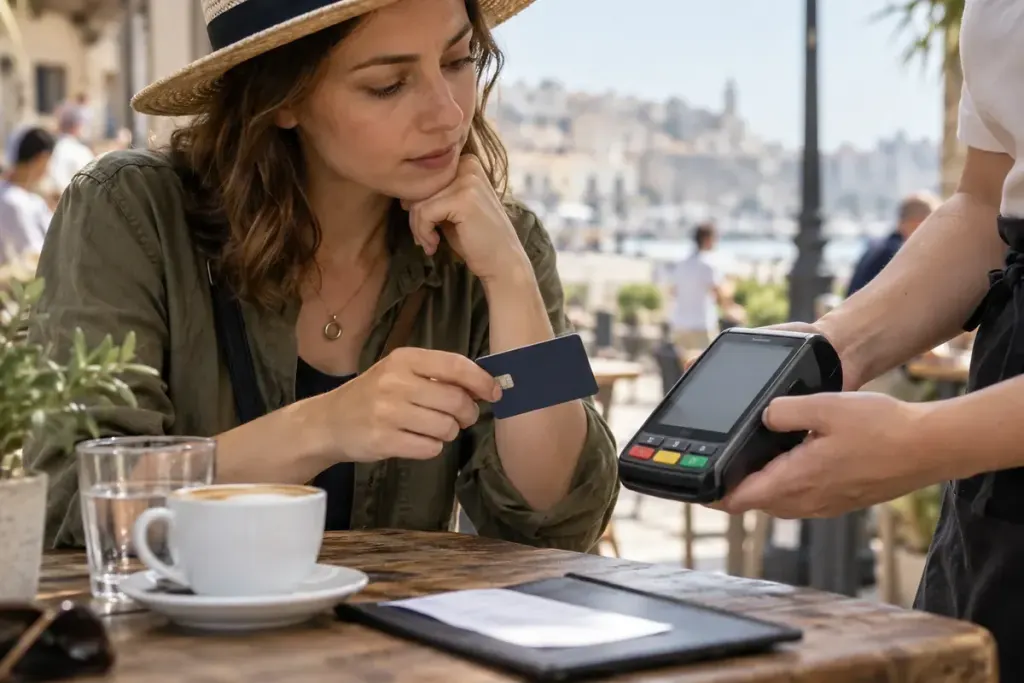
The waiter hands you a terminal showing a familiar currency. That can feel reassuring after a day of mental arithmetic. Yet the familiar number may be an offer to buy a currency-conversion service, rather than a simple translation of the local price.
Identify which conversion you are accepting
With dynamic currency conversion, the merchant or ATM offers to bill you in your home currency. Visa explains that the offer should show both currency amounts, the exchange rate and any additional markup or fees. You should be allowed to choose. A coloured button or the word “convenient” is not enough information to compare costs.
Paying in the merchant’s local currency generally leaves conversion to your card’s payment arrangements. That does not mean every card is fee-free. Check the issuer’s foreign-transaction and exchange-rate terms before travelling, and keep those charges separate from a merchant’s conversion offer.
Compare the same purchase
Consider an illustrative bill of 80 local units. The useful comparison is between the offered home-currency total and what your card terms imply for those same 80 units. Do not compare one total including fees with another exchange rate that excludes them. An ATM withdrawal can also involve a separate operator charge; declining conversion does not necessarily remove that charge.
If the screen is unclear, pause before approving. Ask to see the local-currency amount and conversion details again. A busy queue is a poor reason to accept a service whose price you cannot read.
Keep a record that can explain the statement
Save the receipt showing the transaction currency and amount. When the charge posts, compare it with the final statement rather than relying solely on a pending notification. If conversion was selected without your agreement, raise the specific discrepancy with your card issuer. Note what the terminal displayed and which option you chose; that is more useful than simply saying the exchange rate felt expensive.